BIT Anonymizer
Datenschutzkonforme Datenweitergabe ermöglichen
Overview
The manual redaction of sensitive data in court files and other documents is a time-consuming and error-prone process that must currently be performed entirely by hand. The BIT Anonymizer automates the detection and redaction of confidential information and can additionally convert unstructured data, such as scanned PDFs, into machine-readable formats. The tool transforms a laborious manual task into an automated, reliable process while simultaneously creating the foundation for modern data analysis in numerous socially relevant fields.
What problem does the BIT Anonymizer solve?
Manually removing or blacking out sensitive data is a time-consuming and error-prone process. In many cases – for example, medical data, court documents, or research materials – personal information must be anonymized before it can be shared in order to comply with data-protection regulations.
The BIT Anonymizer solves this problem through automated, secure, and GDPR-compliant processing.
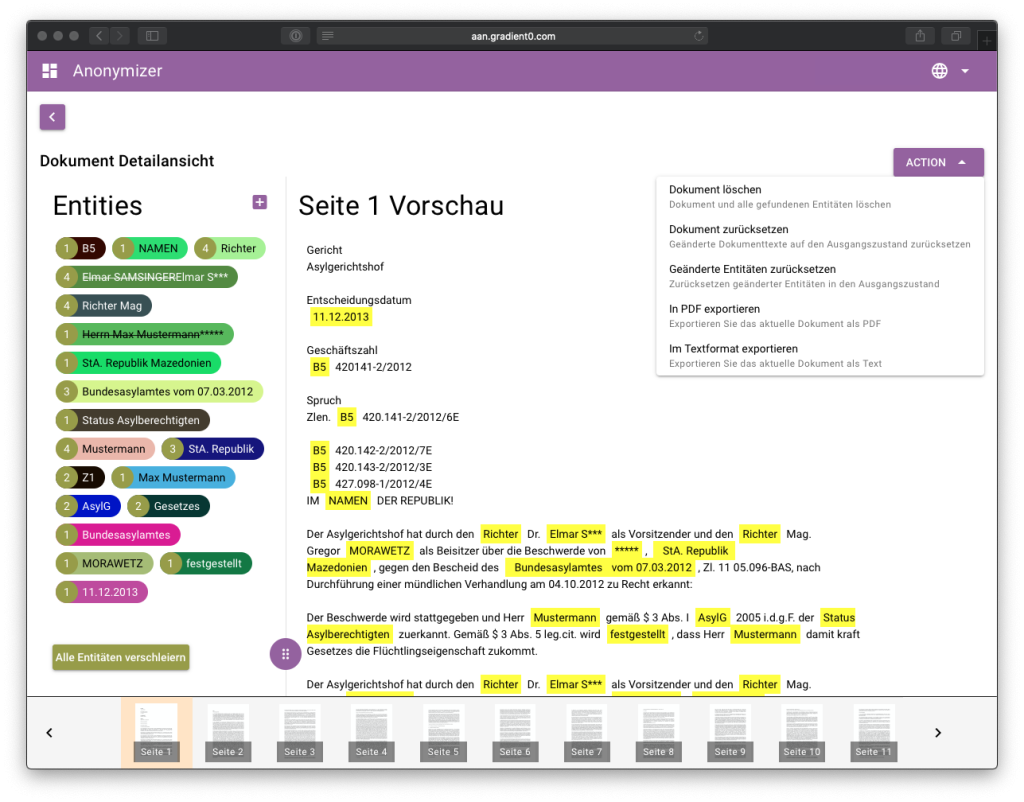
With the tool, data can be shared with third parties without exposing sensitive information. An algorithm automatically detects and hides protected content. The data owner no longer needs to edit information manually but simply defines the desired anonymization rules and reviews the results before release.
This allows data to be anonymized (personal information removed) or pseudonymized (personal information replaced with placeholders) – quickly, reliably, and in compliance with the GDPR.
Functionality and Advantages
The BIT Anonymizer enables machine-based processing of sensitive datasets that can then be safely shared with third parties.
The algorithm automatically detects personal details – such as names, addresses, or case numbers – and removes or replaces them according to the selected settings.
This ensures both data protection and data integrity, while preserving the informational value of documents for research, administration, or analytical purposes.
The data owner retains full control: the data to be processed is reviewed within the application before it is released.
Example: Court Decisions
A practical example is access to court rulings.
A governmental data center could grant judges or research institutions centralized access to all anonymized court decisions of a country.
This would open new opportunities for analyzing judicial practice – without violating privacy rights or data-protection requirements.The visibility of data can be configured so that parties involved in proceedings or other sensitive content always remain protected. This principle can also be applied to sectors such as healthcare, public administration, or scientific research.
Combination withDQ0
The BIT Anonymizer can be seamlessly combined with the TÜV-certified platform DQ0.
The data to be anonymized is processed within a protected data quarantine – a so-called “enclave.” The anonymization takes place entirely inside this secure environment, ensuring that no sensitive information leaves the platform.
Only the reviewed, legally safe output is released for use outside of DQ0.
This combination provides an exceptionally high level of data security and compliance for applications in research, administration, and medicine.
Certification
The related DQ0 platform is already TÜV-certified.
It meets the highest standards of data protection, IT security, and auditability – a crucial trust factor for use in sensitive areas.
Who benefits and how?

Companies and Public Administration
Benefit from significant time savings and resource efficiency, as manual work is eliminated.

Research Institutions
Gain access to anonymized data that can be safely used for scientific purposes.

Healthcare Sector