Hematopoiesis and Leukemia Simulations
Improving medical education
Overview
Hematopoiesis is one of the most complex processes in the human body and is often difficult for medical students to understand. Yet it is central to the training of physicians and researchers across many medical fields. Our project presents hematopoiesis as a realistic simulation, making complex processes easy to comprehend.
What problem does the simulation of hematopoiesis and leukemia solve?
Hematopoiesis is one of the most complex processes in the human body and is often difficult for medical students to understand. Yet it is central to the training of physicians and researchers across many medical disciplines.
Our project presents this process as a realistic, interactive simulation, making the complex dynamics of hematopoiesis and the development of leukemia easy to comprehend.
Since blood-forming cells divide and differentiate billions of times daily, they are particularly susceptible to mutations. Some of these changes can cause healthy cells to become cancerous and grow uncontrollably—resulting in blood cancer, often in the form of leukemia. Our model allows these processes to be visualized dynamically and understandably for the first time.
Mathematical model and application
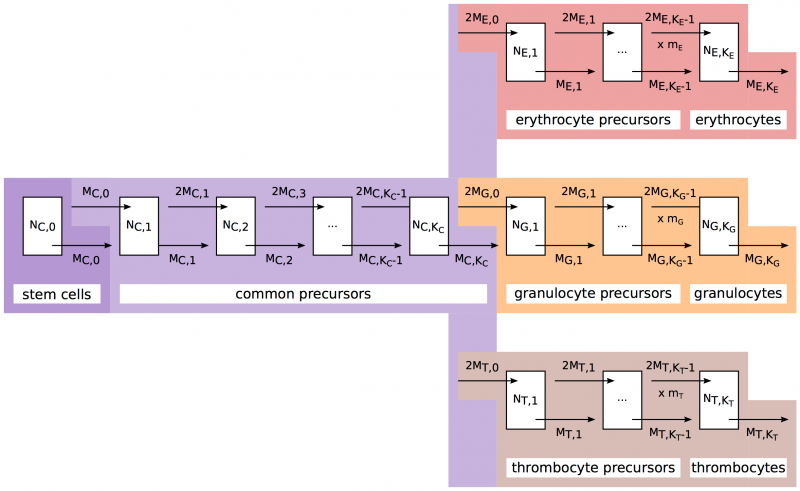
In collaboration with Prof. Dr. Drs. h.c. Roland Heinrich Mertelsmann (University Hospital Freiburg), a mathematical model of the human hematopoiesis system was developed that can be simulated on a computer.
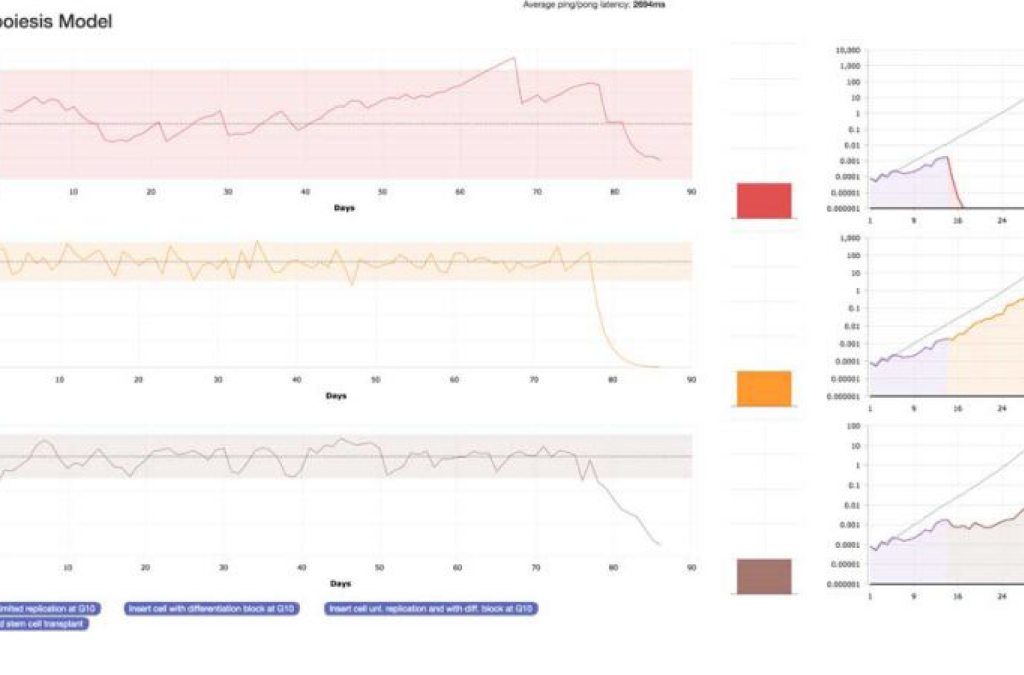
Using this model, the genesis, development, and treatment of leukemia are studied. The simulation demonstrates how different mutations or their sequences influence disease progression. Additionally, various therapies—such as medications or stem cell transplants—can be virtually tested, and their effects on blood parameters can be observed.
This project opens new possibilities for the precise visualization of complex biological processes and contributes to a better understanding of disease mechanisms.

Interactive use
The simulation is available as an online application. Users can interact with the model in real time, introduce mutations, and observe their effects on red and white blood cells.
Additionally, a virtual patient can be treated—such as through a stem cell transplant—and the course of recovery can be tracked. This interactive component makes the application particularly valuable for education, research, and medical training.
Who benefits and how?

Medical students
Gain a visual, interactive representation of hematopoiesis and can better understand complex processes.

Instructors
Have a modern, effective tool for knowledge transfer.

Leukemia patients
The tool already enables the simulation of blood responses to various therapies. With appropriate funding, a digital twin could be developed to accurately predict individual therapy outcomes in advance.