
High-Dimensional Cancer Data Visualization
Data-Driven Support for Complex Medical Decisions
Overview
Today’s medicine is so complex that treating physicians can no longer fully track all individual disease courses, which can lead to misdiagnoses. The developed AI-powered cancer data analysis tool addresses this problem. By visualizing cancer data and performing similarity analyses, it helps verify seemingly straightforward symptoms and avoid misdiagnoses. Already successfully tested with Prof. Mertelsmann at the University Hospital in Freiburg, the tool provides data-driven support for complex medical decisions.
What problem does the visualization of high-dimensional cancer data solve?
Modern cancer research deals with enormous and complex datasets. Thanks to advanced sequencing technologies, it is now possible to capture gene expression data for tens of thousands of genes across thousands of tissue samples. These large volumes of data offer new opportunities to identify overarching patterns in cancer development—but they also present a central challenge for researchers and clinicians: the data are too high-dimensional to be intuitively understood or visualized using conventional methods.
Without suitable tools, crucial relationships in the genetic basis of cancer remain hidden. This is exactly where our project comes in.
Technology and methodology
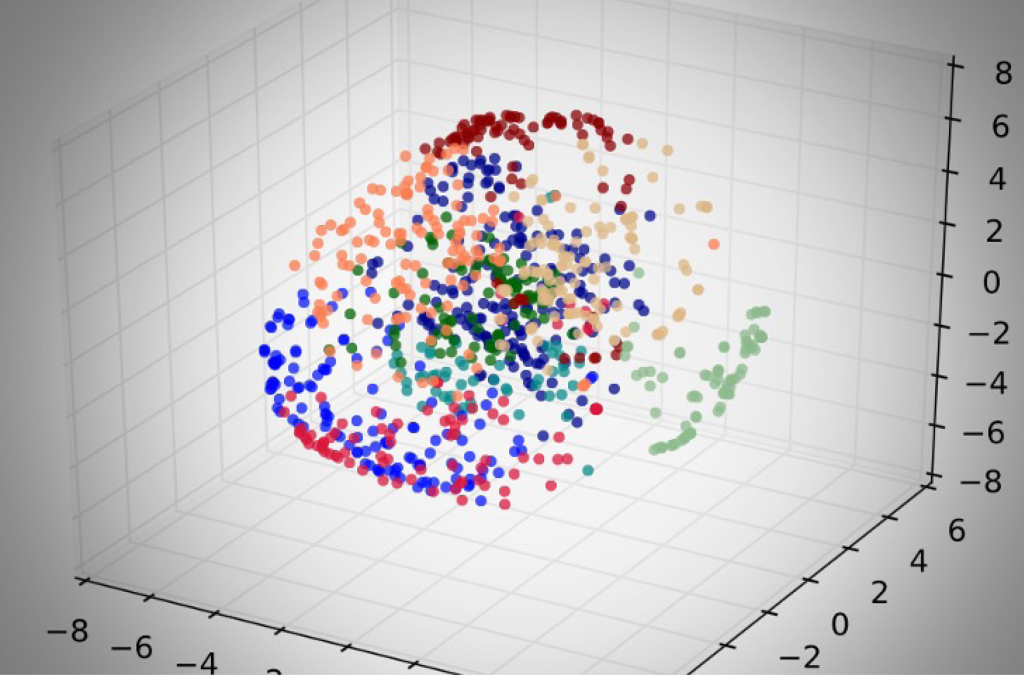
We applied a deep autoencoder, a specialized form of deep neural network, to the largest publicly available dataset of gene expression profiles across various cancer types.
This dataset comprises tens of thousands of dimensions from thousands of tissue samples of different cancers. The neural network was trained completely unsupervised, with no information about the cancer types from which the samples originated.

Significance for research and medicine
The results demonstrate that deep learning methods can structure and visualize highly complex biomedical data in an understandable way. This enables researchers to uncover new correlations between gene expression and disease phenotypes that would have remained hidden using traditional methods.
This approach represents an important step toward data-driven, AI-supported cancer research—it facilitates the identification of cancer-specific gene patterns, supports diagnostics, and opens new avenues for personalized therapy strategies.*
Who benefits and how?

Researchers

Medical professionals
Can better understand complex molecular relationships and incorporate them into clinical decision-making processes.

Society and healthcare system
Benefit in the long term from more precise diagnoses, targeted therapies, and the accelerated development of personalized treatment strategies.